
Madagascar grows most of the world’s vanilla. Uganda grows some of the best of it — and almost nobody outside the flavor industry knows why.
This guide covers everything that matters about Ugandan vanilla beans: where they come from, why they taste the way they do, how Uganda’s unique two-harvest cycle works, how the beans compare to other origins, which grades exist, and how to actually buy them at fair prices. It’s written by Evanille — we run our own sourcing, curing, and grading operation in Uganda and ship from our warehouse in Florida, so this is first-hand knowledge, not a rewritten Wikipedia entry.
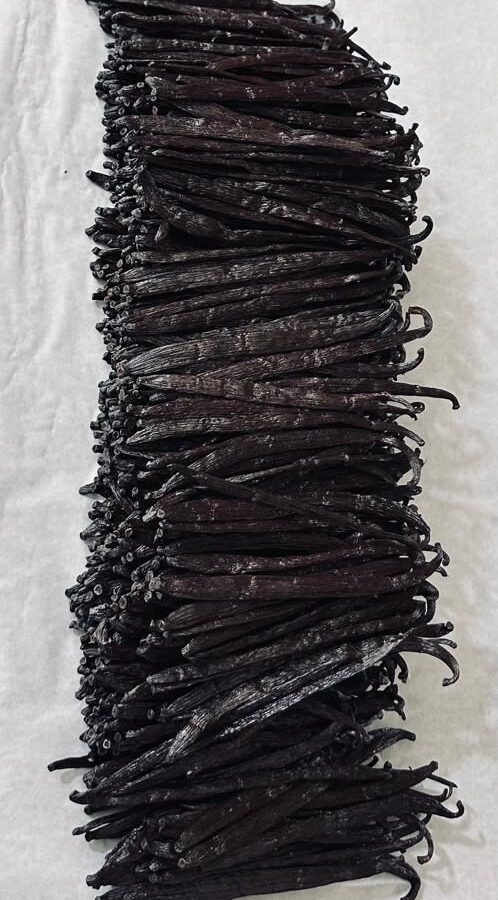
What are Ugandan vanilla beans?
Ugandan vanilla beans are the cured fruit of Vanilla planifolia — the same species grown in Madagascar — cultivated near the equator in Uganda, primarily in the central and western districts around Mukono, Kayunga, Bundibugyo, and the Lake Victoria basin.
Same species, very different result. Uganda’s rich volcanic and lake-basin soils, equatorial sun, and distinct curing traditions produce a bean that is bolder, earthier, and typically higher in vanillin than its Madagascar cousin. Uganda is now the world’s second-largest producer of natural vanilla, and its beans have quietly become a favorite of commercial extract makers who want more flavor per kilogram.
Key characteristics at a glance:
| Attribute | Ugandan vanilla beans |
|---|---|
| Species | Vanilla planifolia (Bourbon-type) |
| Flavor profile | Bold, creamy, earthy, with chocolate and fig undertones |
| Vanillin content | High — well-cured lots routinely test at the top of the 1–2% range typical for cured vanilla, often above comparable Madagascar lots |
| Harvests per year | Two (Uganda’s defining advantage) |
| Typical bean length | 14–20+ cm for Grade A |
| Best uses | Extracts, pastes, ice cream, chocolate, baking, brewing |
A short history of vanilla in Uganda
Vanilla is not native to Africa — it’s a Mexican orchid that must be hand-pollinated everywhere it grows outside Mesoamerica. It reached Uganda in the early 20th century and was being grown commercially by the 1920s under British colonial agriculture programs, planted in the same fertile belt that grows Uganda’s coffee and cocoa.
The industry then survived a brutal century:
- 1920s–1960s — Steady smallholder production develops around Mukono and the Lake Victoria crescent.
- 1970s–1980s — Uganda’s vanilla trade collapses along with the broader economy during the Idi Amin era and the wars that followed. Vines survive in farmers’ gardens; the export market disappears.
- 1990s — International spice buyers help revive commercial production, replanting and training thousands of smallholders. Uganda re-enters the world market.
- 2015–2020 — The global vanilla price spike (driven by cyclone damage in Madagascar) sends prices toward $600/kg and triggers a planting boom in Uganda — along with a wave of premature harvesting and bean theft.
- Today — The Ugandan government declares official harvest-opening dates each season to combat under-ripe picking, a quality-protection policy few origins have. Uganda has emerged as the most credible large-scale alternative to Madagascar.
That last point matters more than it seems. Vanilla picked before full maturity never develops proper vanillin, no matter how well it’s cured. A government-enforced harvest window is a structural quality advantage.
The Ugandan flavor profile: bold, chocolatey, built for extraction
If Madagascar vanilla is the familiar, sweet, creamy vanilla of premium ice cream, Ugandan vanilla is its darker, more intense sibling.
Cured Ugandan beans typically show:
- High vanillin. Cured vanilla beans in general contain roughly 1–2% vanillin by weight; well-cured Ugandan lots consistently land at or above the top of that range — Evanille’s own beans test at 2.5%, in both grades — and frequently exceed comparable Madagascar lots in lab analysis. In practice: more vanilla punch per bean.
- Bold, dark base notes. Chocolate, fig, raisin, and a mild smoky earthiness — closer to a dark cacao character than to the floral sweetness of Tahitian vanilla.
- A creamy, buttery mid-palate that still reads unmistakably as classic “Bourbon vanilla,” because it is the same planifolia species.
- Strength that survives processing. The bolder profile holds up through heat, alcohol extraction, dairy fat, and long bake times — which is exactly why extract producers, breweries, and chocolate makers gravitate to Uganda origin.
Where the profile shines: vanilla extract (single and multi-fold), vanilla bean paste, chocolate and confectionery, coffee and stout brewing, ice cream bases that need to cut through cream and sugar, and any baked good where you want the vanilla to actually be tasted.
Where you might still choose another origin: delicate applications built around floral top notes — some pastry chefs prefer Tahitian (V. tahitensis) for fruit desserts, and some legacy brands stay with Madagascar purely for profile consistency with their existing formula.
Uganda’s two-harvest cycle: why supply never stops
This is the single most important thing to understand about Uganda as an origin, and the reason manufacturers are moving contracts there.
Uganda sits directly on the equator. Its vanilla orchids flower twice a year, which produces two full harvests annually — roughly:
| Harvest | Flowering | Harvest window (approx.) | Reaches US market |
|---|---|---|---|
| Main crop | Oct–Dec | June–August (government-declared dates) | Late in the same year |
| Second crop (“fly crop”) | Apr–Jun | December–February | Mid-year |
Madagascar, Indonesia, Mexico, and Tahiti each harvest once a year. That single-crop rhythm is why the vanilla market lurches: one cyclone in Madagascar’s SAVA region, one bad flowering season, and the entire world’s supply for that year is set.
Uganda’s dual cycle means:
- Fresh beans enter the supply chain every six months — inventory is younger, on average, when it reaches you.
- Supply risk is halved. A weak season is followed by another chance six months later, not eighteen.
- Importers with Uganda operations can hold true year-round stock. This is how Evanille keeps bulk vanilla beans available continuously from our Florida warehouse instead of rationing a once-a-year shipment.
For a deeper origin-vs-origin breakdown, see our full comparison: Ugandan vs Madagascar vanilla.
How Ugandan vanilla compares to other origins
| Origin | Species | Harvests/yr | Flavor profile | Typical role |
|---|---|---|---|---|
| Uganda | planifolia | 2 | Bold, chocolatey, earthy, high vanillin | Extracts, manufacturing, bold baking |
| Madagascar | planifolia | 1 | Sweet, creamy, classic “vanilla” | Premium retail, legacy formulations |
| Indonesia | planifolia | 1 | Smoky, woody (often heat-cured) | Blending, budget extract |
| Mexico | planifolia | 1 | Creamy with spice/woody notes | Specialty culinary |
| Tahiti | tahitensis | 1 | Floral, fruity, anise, cherry | Pastry, perfumery |
The honest summary: Madagascar remains the reference profile the world grew up on. Uganda delivers equal-or-higher vanillin, a bolder flavor, twice the harvest frequency, and — because the origin carries no “Madagascar premium” — consistently better value per kilogram of delivered flavor.
Grades of Ugandan vanilla beans
Grading is about moisture and appearance, not flavor quality — Grade A and Grade B beans come off the same vines. (Full breakdown: Grade A vs Grade B vanilla beans.)
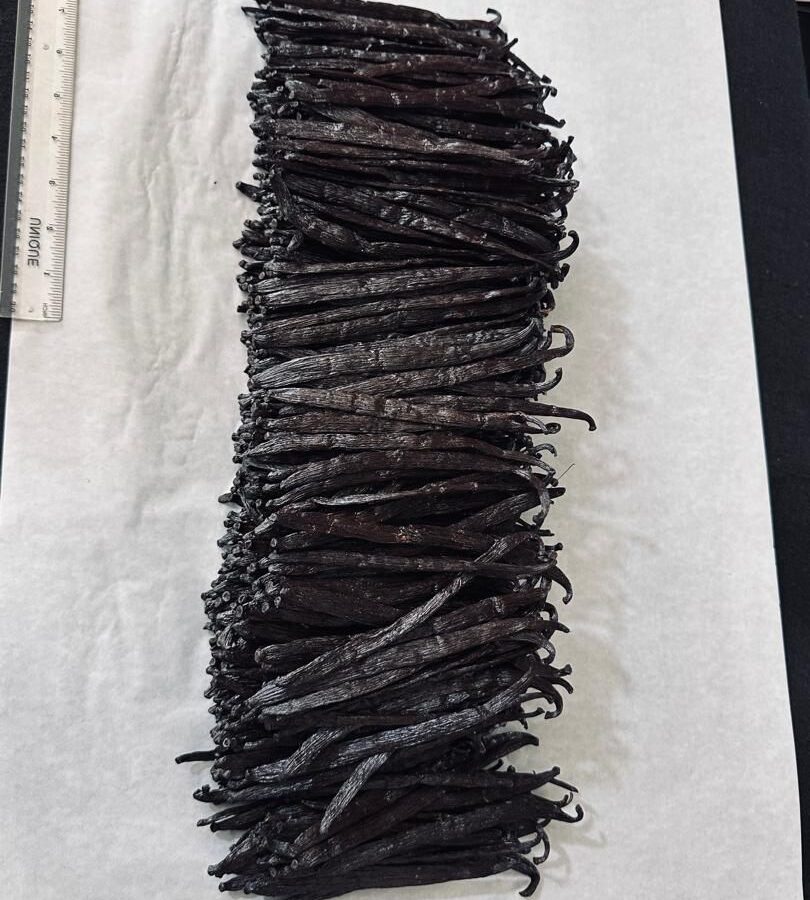
- Grade A (Gourmet). Moisture 32% in Evanille’s lots. Plump, oily, flexible, unblemished, 5–6 in (13–15 cm), roughly 125–150 beans to the pound. The bean you split for caviar, use whole in pastry, or showcase in premium paste and retail extract. Shop Grade A gourmet Ugandan vanilla beans.
- Grade B (Extract grade). Moisture 28% — drier, but only by four points. May show splits or surface blemishes. Vanillin is identical to Grade A at 2.5%, and the moisture gap is worth about 6% more dry bean solids per pound: a genuine but minor edge. What makes Grade B the professional standard for extraction is that it costs roughly half as much and its flaws are invisible once the pod is chopped. Shop extract grade vanilla beans.
- Splits and cuts. Beans that split on the vine or during curing. Cosmetic issue only; excellent extraction value, and the open pod extracts faster.
Who should buy Ugandan vanilla beans?
- Extract producers — the highest-value use case. 2.5% vanillin at Grade B prices means the lowest cost per kilo of vanilla solids on the market, which lands straight on extract economics. Grade B Uganda is arguably the best extraction value available. (See our technical guide: how to make vanilla extract to the FDA single-fold standard.)
- Food and beverage manufacturers — ice cream, chocolate, baked goods, spirits, kombucha, cold brew. The bold profile survives processing; the two-harvest cycle de-risks annual supply contracts.
- Bakeries and pastry programs — Grade A Uganda gives visible caviar and a vanilla flavor customers actually notice.
- Distributors and repackers — Uganda origin is an underserved story with real differentiation versus the hundredth “Madagascar Grade A” listing.
- Home extract makers and enthusiasts — a pound of Ugandan Grade B legally yields about 1.15 gallons of single-fold extract (13.9 oz of beans per gallon at 28% moisture). Small investment, year of extract.
How to buy Ugandan vanilla beans (without getting burned)
The vanilla trade has a long middleman chain — farmer, collector, exporter, importer, distributor, reseller — and every link adds markup and subtracts traceability. When evaluating a supplier, ask:
- Are they the importer or a reseller? Most US “wholesale” vanilla sellers buy from importers and re-bag. Evanille sources, cures, and grades at our own facility in Uganda and imports directly to Florida — one supply chain, fully traceable to lot level.
- Can they state moisture content and grade specs? “Grade A” without a moisture number is a vibe, not a spec.
- Where is the stock physically? US-warehoused beans mean days, not months, to your door — Evanille ships from Florida, with overnight available.
- Is pricing published? Opaque “request a quote” pricing usually means the price depends on how much they think you’ll pay. Our wholesale pricing tiers are published, from a single pound up; tonne lots are quoted under contract.
- Can they supply year-round? Single-origin-Madagascar suppliers physically cannot; two Ugandan harvests mean we can.
Browse the full range of Ugandan vanilla beans — Grade A, Grade B, and bulk, or request wholesale pricing for volume orders.
FAQ
Are Ugandan vanilla beans as good as Madagascar?
They’re the same species (Vanilla planifolia) grown in comparable equatorial conditions, and well-cured Ugandan beans typically match or exceed Madagascar lots in vanillin content. The difference is profile, not quality: Uganda is bolder and more chocolatey, Madagascar sweeter and creamier. For extraction and manufacturing, many buyers now consider Uganda the better value.
Why does Uganda have two vanilla harvests per year?
Uganda sits on the equator, so its vanilla orchids flower twice annually — roughly October–December and April–June — producing harvests around June–August and December–February. Every other major origin harvests once a year.
What do Ugandan vanilla beans taste like?
Classic Bourbon vanilla at the core — creamy and sweet — layered with distinctly bold, dark notes: chocolate, fig, raisin, and mild earthiness. The profile is more intense than Madagascar and holds up better through heat and processing.
Are Ugandan vanilla beans good for making extract?
Exceptionally. Vanillin at 2.5%, a flavor bold enough to survive alcohol extraction, and Grade B pricing at roughly half of gourmet make Ugandan extract-grade beans one of the best extraction values available. One pound yields roughly 1.15 gallons of FDA single-fold extract — 13.9 oz of beans per gallon once the 13.35 oz standard is adjusted for 28% moisture.
How much do Ugandan vanilla beans cost?
Pricing moves with the global market, but Uganda origin typically undercuts equivalent Madagascar grades because it doesn’t carry the name premium — while buying from the actual importer removes reseller markups on top. Evanille publishes current per-kilo tiers on our wholesale page.
How should I store vanilla beans?
Airtight, cool (not refrigerated — condensation risk), and dark. Vacuum-sealed or in wax-lined bags, glass jars, or food-grade poly, at room temperature. Properly stored Grade A beans keep 12+ months; Grade B even longer. Check monthly and air briefly if any moisture appears.