
Vanilla Beans for Ice Cream & Gelato
Vanilla is the most-ordered scoop in almost every shop, the benchmark a new customer judges you by, and the only flavor where the difference between real beans and a flavoring is visible in the tub before anyone tastes it.
This page is written for people who run a batch freezer: how much bean per liter, how to steep it, what grade to buy for a dairy base, what it costs per scoop, and how much to keep in the back for a month of production.
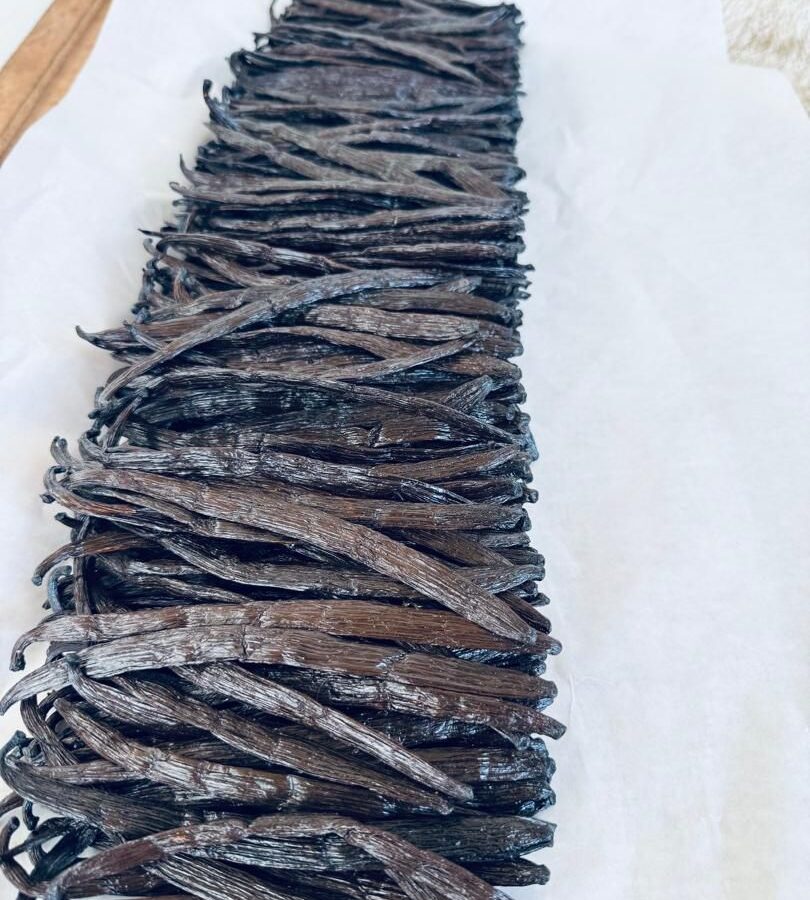
Buying by the pound or the kilo? See current pricing or text us at +1 786-896-8446 — we’ll call you back.
Why whole beans beat extract in a frozen dairy base
In a warm application a good extract can carry a recipe. In a frozen one, three things work against it.
Cold suppresses aroma. Frozen product mutes flavor perception — the same base tastes noticeably stronger at 40°F than at 5°F. You need more aromatic intensity going in than a warm custard would need, not less.
Fat is the delivery system, and the bean loads it. Vanillin dominates, but a cured bean carries a couple of hundred other aroma compounds, many of them fat-soluble. In a dairy base they partition into the butterfat and release as the scoop melts — exactly when your customer is tasting it. An alcohol extract delivers a vanillin-forward flavor that reads thinner through a cold fat matrix.
The specks are the proof. Caviar in a pale base is the clearest visual signal that a product is made with real vanilla, and the reason a vanilla scoop can be priced as a premium flavor rather than a default one. You cannot fake it.
One practical wrinkle too: alcohol depresses the freezing point of a mix. Push extract hard enough for real intensity and you’ve also softened the product. Beans give you flavor without touching your hardness curve.
Dosage: how much vanilla per liter of base
The professional range for artisan ice cream and gelato is roughly 0.5 to 2 beans per liter of mix, depending on whether vanilla is a supporting note or the whole point. Our Grade A beans run 5–6 inches (13–15 cm) and about 3.3 grams each — 125–150 to the pound.
| Intensity | Beans / liter of base | Approx. grams / liter | Where it fits |
|---|---|---|---|
| Supporting (vanilla behind another flavor) | 0.5 | ~1.7 g | Fior di latte, cheesecake, caramel, fruit bases needing a backbone |
| Standard bean-forward | 1 | ~3.3 g | The artisan default: clear vanilla identity, good speck density |
| Signature / super-premium | 1.5–2 | ~5–7 g | Your flagship vanilla, competition batches, tasting-menu work |
Weigh, don’t count. Ours run 3.0–3.6 g each, but across suppliers and lots the spread is far wider, so “two beans” can mean a 100% swing in dosage between deliveries. Set your spec in grams per liter and it stays true. Many shops also split the job: 0.75 bean per liter for caviar and body, plus a small dose of their own bean-made extract for the top note — see our extract guide.
Grade A or Grade B for ice cream?
It depends on whether you’re scraping or steeping.
Grade A gourmet — the default. At 32% moisture the pod is supple, splits cleanly, and gives up its caviar in one pass. That matters when a prep cook is scraping 40 beans before service. Grade A is what you want any time the seeds stay in the finished product.
Grade B / extract grade — for steep-and-strain and in-house extract. Slightly drier at 28% moisture — a four-point gap, worth about 6% more dry solids per pound, so treat it as a rounding difference rather than a flavor upgrade. What makes it worth buying is the price: roughly half of Grade A at the same 2.5% vanillin. It scrapes less willingly, so it’s the wrong tool for a speckled flagship vanilla.
Splits and cuts are cosmetic seconds at a lower price with the flavor fully intact — free money in any base that gets strained.
Origin matters too. Ugandan Vanilla planifolia sits at the high end of the vanillin range with a bold, chocolate-toned profile — precisely the character that survives a cold, fatty, high-sugar matrix, where softer origins fade. More: our Uganda operation.
Steeping method: getting the flavor into the base
- Split and scrape. Flatten the bean, run a paring knife tip down its length, then scrape the caviar with the back of the blade so you don’t shred the pod. Reserve both.
- Add caviar and pods to the dairy as you heat the milk and cream. Rub the seeds into a little sugar first — they clump in cold liquid and disperse cleanly in sugar.
- Hold hot, off heat, covered. After pasteurization (or scalding to about 175°F / 80°C), pull the pot, cover it, and let the pods sit 30–60 minutes. Covered is not optional — uncovered, your aromatics leave with the steam.
- Age the base. Standard gelato practice is 4–12 hours at 4°C, and the vanilla keeps infusing the whole time. Leave the pods in and strain at the end. Highest-return step there is: same beans, meaningfully more flavor.
- Keep the pods. Rinse, dry thoroughly, and bury them in sugar. There’s real flavor left after one infusion.
What it actually costs per scoop
A pound of Grade A beans at 5–6 inches is roughly 125–150 beans. At the standard 1 bean per liter:
| Beans purchased | Beans (approx.) | Liters of base at 1 bean/L | Finished gelato @ 30% overrun | 4 oz scoops |
|---|---|---|---|---|
| 1 lb | 125–150 | ~140 L | ~180 L | ~1,500 |
| 1 kg | 275–330 | ~300 L | ~390 L | ~3,300 |
| 5 lb | 625–750 | ~690 L | ~900 L | ~7,600 |
At the US market benchmark of about $100/lb for Grade A, that’s roughly $0.73 per liter of base — about $0.07 per 4 oz scoop. From us, Grade A gourmet is $82 per pound and $165 per kilo, which brings it to about $0.55 per liter — roughly $0.05 a scoop. Full ladder on our prices page.
Five cents a scoop, on a scoop you sell for five dollars. Real vanilla is not the line item hurting your food cost — and it’s the one your customer can see.
How much a shop needs per month
Planning numbers at 1 bean per liter of base:
- Small shop / seasonal stand — 20–30 L of vanilla base per week → about 1 lb per month
- Established single location — 60–80 L per week → 2–2.5 lb per month
- Multi-location or wholesale pints — 150–200 L per week → 5–6.5 lb (2.2–3 kg) per month
- Small manufacturer — 500 L+ per week → 16 lb+ per month, and you belong on wholesale tiers
Order about a quarter at a time if your storage is stable — beans hold well for 6–12 months sealed, cool and dark, and larger units drop your per-pound cost. See how to store vanilla beans.
Buying from Evanille
We’re not a broker. Evanille runs its own sourcing, curing, grading and QC operation in Uganda and stocks the finished beans in a Florida warehouse, so an order placed today ships domestically — overnight if a production run can’t wait.
- 1 lb ($82) and 1 kg ($165) — Grade A gourmet, for single-location shops
- 10 kg box ($1,200 · $120/kg) and 25 kg splits case ($1,500 · $60/kg, free delivery) — Grade A gourmet, for multi-location and small manufacturing
- 20 kg boxes ($1,200 · $60/kg) down to $40/kg at 500 kg+ — Grade B extract grade, in US stock; tonne lots quoted under contract
- Two Ugandan harvests a year — December–February and June–August — we resupply twice annually, so your March order doesn’t depend on how one Madagascar harvest went
Browse all vanilla beans, check pricing, or text +1 786-896-8446 with your weekly base volume — we’ll tell you what to order and how often, and send samples.
FAQ
How many vanilla beans do I need per liter of ice cream base?
Between 0.5 and 2 beans per liter, with 1 bean (about 3.3 grams) per liter as the standard for a bean-forward artisan vanilla. Use 0.5 when vanilla is a supporting note and 1.5–2 for a flagship or competition batch. Ours run 3.0–3.6 g at 125–150 beans per pound, but bean weight varies enough between suppliers that you should set your spec by weight rather than by count.
Are vanilla beans better than extract for ice cream?
For the flagship vanilla, yes. Whole beans deliver the visible caviar customers read as proof of real vanilla, and they bring fat-soluble aroma compounds that carry through a cold, high-fat base — where an alcohol extract reads thinner. Extract is a fine supporting dose or a good addition on top of beans; it’s a poor sole source in frozen dairy.
Should I use Grade A or Grade B vanilla beans for gelato?
Grade A for anything where the seeds stay in the product — at 32% moisture it’s pliable and scrapes cleanly. Grade B for steep-and-strain bases and for making your own extract: at 28% it’s marginally drier (about 6% more dry solids, not a meaningful flavor difference — vanillin is 2.5% in both) and roughly half the price, which is the actual reason to use it. Many shops keep both.
How much does real vanilla add to the cost of a scoop?
At 1 bean per liter of base and roughly $100 per pound of Grade A at market benchmarks, real vanilla costs about $0.73 per liter of base — around $0.07 per 4 oz scoop at typical gelato overrun. At our $82/lb, it’s closer to $0.05 a scoop. One pound of beans covers around 1,500 scoops.