
Madagascar produces roughly three-quarters of the world’s natural vanilla. It also produces most of the world’s vanilla price crises. Every time a cyclone crosses the SAVA region or a speculative bubble inflates, the entire industry — from home bakers to multinational ice cream brands — pays for the concentration risk of a single-origin supply chain.
Uganda is the origin the flavor industry increasingly turns to as the answer. Same species, comparable or higher vanillin, two harvests a year instead of one, and no name-brand premium baked into the price.
We import Ugandan vanilla — that’s our bias, stated up front. But we’ll make the honest case, including where Madagascar genuinely wins, because buyers who understand both origins make better decisions than buyers who read marketing.
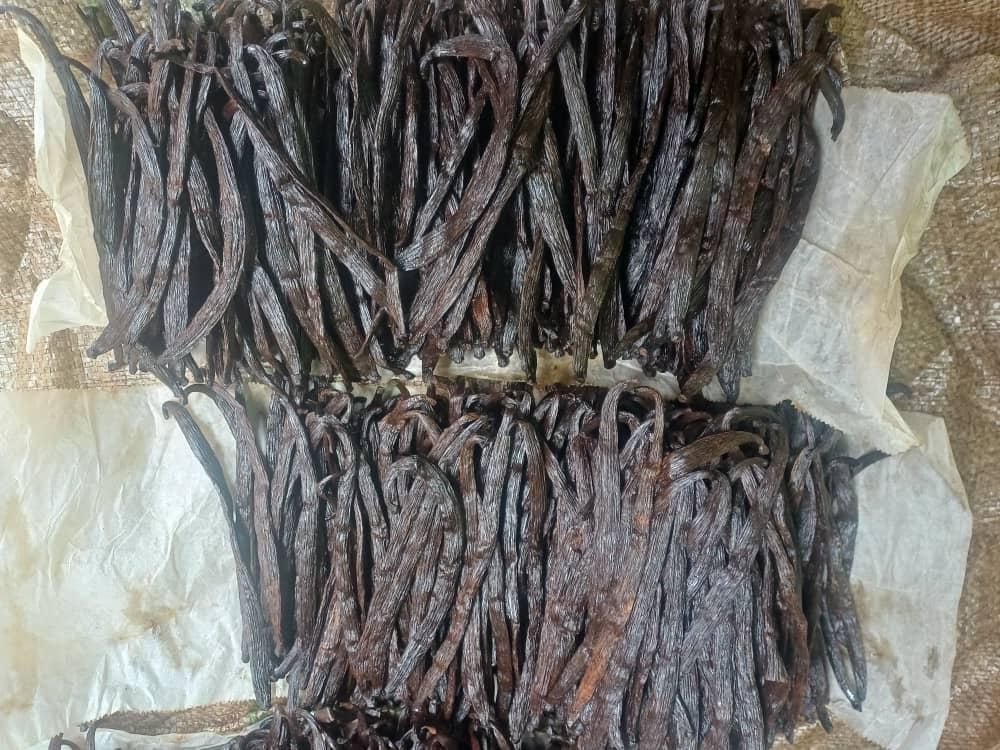
The comparison at a glance
| Factor | Ugandan vanilla | Madagascar vanilla |
|---|---|---|
| Species | Vanilla planifolia | Vanilla planifolia |
| Flavor profile | Bold, creamy, chocolate/fig undertones, earthy depth | Sweet, creamy, classic “vanilla” with light woody notes |
| Vanillin content | High — well-cured lots at or above the typical 1–2% range; Evanille’s own Ugandan beans test at 2.5% in both grades | Benchmark quality — typically ~1.5–2% for well-cured Grade B |
| Harvests per year | Two (main: June–Aug; fly crop: Dec–Feb) | One (June–Aug) |
| Share of world supply | #2 producer, single-digit-to-teens share (growing) | ~75–80% |
| Price level | Lower for equivalent grade — no origin premium | Carries a name premium at every grade |
| Price stability | More stable — dual harvests, diversified weather exposure | Historically volatile: ~$20/kg (2013) to ~$600/kg (2018) and back down |
| Supply risk | Low-moderate — two chances per year, no cyclone corridor | High concentration risk — one region, one harvest, annual cyclone season |
| Market recognition | Growing; underused as a label claim | Universal — “Madagascar Bourbon” sells itself |
Flavor: the real difference is intensity, not quality
Both origins grow the same orchid, cured by similar Bourbon-method processes (blanching, sweating, sun-drying, conditioning). Blind-tasted as finished extract, they are recognizably siblings. The differences:
Madagascar is the profile the world was raised on: sweet, round, creamy, immediately familiar. It’s the reference against which all vanilla is judged — which is its greatest commercial asset.
Uganda delivers that same Bourbon core with more force: darker base notes of chocolate, fig, and raisin, a mild earthiness, and typically more vanillin per gram. In applications with heat, fat, sugar, or alcohol working against the vanilla — ice cream bases, baked goods, stouts, extracts — the Ugandan profile survives where subtler beans fade.
A useful shorthand: Madagascar is milk chocolate; Uganda is 70% dark. Neither is “better.” One is more familiar; the other is more intense.
Vanillin content
Cured vanilla beans generally contain 1–2% vanillin by weight, with curing skill mattering as much as origin. Independent buyers and flavor houses consistently report Ugandan lots testing at the high end or above it — our own beans come in at 2.5%, the same figure in Grade A and extract grade alike — one reason extract manufacturers, who buy flavor compounds per kilo rather than romance, were the first to move volume to Uganda. If your product is extract, paste, or flavoring, higher vanillin per pound is a direct input-cost advantage.
Price: what you’re actually paying for with “Madagascar”
Two separate premiums are embedded in Madagascar vanilla pricing:
- The name premium. “Madagascar Bourbon” is the only vanilla origin consumers recognize, so every link in the chain charges for the label.
- The volatility premium. Suppliers exposed to a single annual harvest in a cyclone corridor price in their risk. After Cyclone Enawo hit the SAVA region in 2017, market prices ran to roughly $600/kg — briefly making vanilla more expensive than silver — before collapsing again. Buyers locked into Madagascar-only contracts lived every swing.
Ugandan vanilla carries neither premium. For equivalent grade and moisture spec, Uganda origin consistently prices below Madagascar — and when you buy from a company that runs its own Ugandan operation rather than a chain of middlemen, the gap widens further. Evanille publishes its wholesale vanilla bean pricing openly, from a single pound upward (tonne lots quoted under contract), precisely because origin-direct economics make that possible.
Supply: one harvest vs two
This is the structural difference that no amount of Madagascar marketing can close.
Madagascar harvests once, June–August, almost entirely in one northeastern region. The world’s vanilla supply for the year is effectively decided in a single quarter, in a single cyclone-exposed corridor. Add export politics, speculation, and quality pressure during boom years (vacuum-packed under-cured beans, premature picking), and you get the boom-bust cycle the industry knows too well.
Uganda sits on the equator, so vines flower twice a year, yielding two harvests: the main crop around June–August and a second “fly crop” around December–February. The Ugandan government declares official harvest-opening dates each season to prevent premature picking — a quality-enforcement mechanism Madagascar has struggled to implement at scale. Two harvests mean:
- Fresh supply enters the market every ~6 months, not every 12
- A weak season is corrected in half the time
- Importers can hold genuine year-round inventory instead of rationing one annual shipment
When Madagascar wins
An honest comparison names these plainly:
- Label-driven retail. If your bottle says “Madagascar Bourbon Vanilla” and customers buy it for that line, the origin is the product. Switching saves money but costs the claim.
- Legacy formulation match. Long-standing products tuned to Madagascar’s profile may need R&D bench work before switching — most find Uganda a drop-in or an upgrade, but validate first.
- Certified-supply-chain requirements. Madagascar’s mature export industry offers a wider menu of certifications and established broker relationships for buyers whose compliance frameworks require them.
When Uganda wins
- Extract and flavor manufacturing — more vanillin per dollar, and the bold profile concentrates beautifully. Start with extract-grade Ugandan beans.
- Any product where vanilla must survive processing — baking, ice cream, brewing, confectionery.
- Cost-sensitive scaling — equivalent quality without the origin premium.
- Supply-chain de-risking — which is why the smartest large buyers now dual-source rather than switch outright: Madagascar for the label, Uganda for volume and continuity.
- Differentiation — “single-origin Ugandan vanilla” is a story your competitors aren’t telling yet.
Why manufacturers are diversifying to Uganda
The 2016–2020 price crisis was a masterclass in concentration risk, and procurement teams learned it. The pattern since: keep a Madagascar line for label continuity, move base-volume extraction and manufacturing demand to Uganda, and let the two origins hedge each other — Uganda’s December–February fly crop lands exactly when Madagascar’s annual supply is at its oldest.
Evanille exists to make that diversification easy on the US side: we source, cure, and grade at our own operation in Uganda, import directly, and stock Ugandan vanilla beans in Florida for immediate shipment — overnight if needed. Full lot-level traceability, no broker chain.
For the complete picture of the origin — history, curing, grades, and buying guidance — read our complete guide to Ugandan vanilla beans.
FAQ
Is Ugandan vanilla as good as Madagascar vanilla?
Yes — it’s the same species (Vanilla planifolia), and well-cured Ugandan beans match or exceed Madagascar lots in vanillin content. The flavor differs in character: Uganda is bolder with chocolate undertones; Madagascar is sweeter and creamier. Quality per grade is comparable; value usually favors Uganda.
What is the best alternative to Madagascar vanilla?
For most commercial uses, Ugandan vanilla is the strongest Madagascar alternative: same species, comparable-or-higher vanillin, a bold Bourbon profile, two harvests per year for supply stability, and lower prices for equivalent grades. Indonesian vanilla is cheaper still but smokier and typically lower grade; Tahitian is a different species with a floral profile suited to niche pastry use.
Why is Madagascar vanilla so expensive?
Concentration risk plus branding. About 75–80% of world supply comes from one annually harvested, cyclone-exposed region, so shocks move the entire market — prices ran from roughly $20/kg in 2013 to ~$600/kg in 2018. On top of that, “Madagascar Bourbon” carries a consumer-recognition premium at every grade.
Can I substitute Ugandan vanilla 1:1 for Madagascar in extract making?
Yes. Both meet the FDA identity standard for vanilla beans, and the single-fold ratio applies the same way to each: 13.35 oz per gallon for beans at 25% moisture or less, scaled up in proportion for wetter beans. (Evanille’s Ugandan extract grade sits at 28% moisture, so it works out to about 13.9 oz per gallon; the adjustment depends on the lot’s moisture, not on its origin.) Because Ugandan beans often carry more vanillin — ours test at 2.5% — the resulting extract typically tastes as strong or stronger at the same legal ratio. See our FDA single-fold extract guide.
Does Uganda really harvest vanilla twice a year?
Yes. Uganda’s equatorial position produces two flowering cycles, giving a main harvest around June–August and a second crop around December–February, with official harvest dates declared by the government each season. It’s the only major origin with a genuine dual harvest.