
Here’s the misconception that costs vanilla buyers the most money: that Grade B is “worse” vanilla.
It isn’t. Grade A and Grade B beans grow on the same vines, on the same farms, and are cured in the same facilities. The grade describes moisture content and appearance — not flavor quality, not vanillin, not freshness. Once you understand that, choosing the right grade becomes a simple question: how will you use the bean? Get it right and you’ll never overpay for cosmetics — or under-buy on presentation — again.
As an importer that grades beans at our own facility in Uganda, here’s the complete picture.
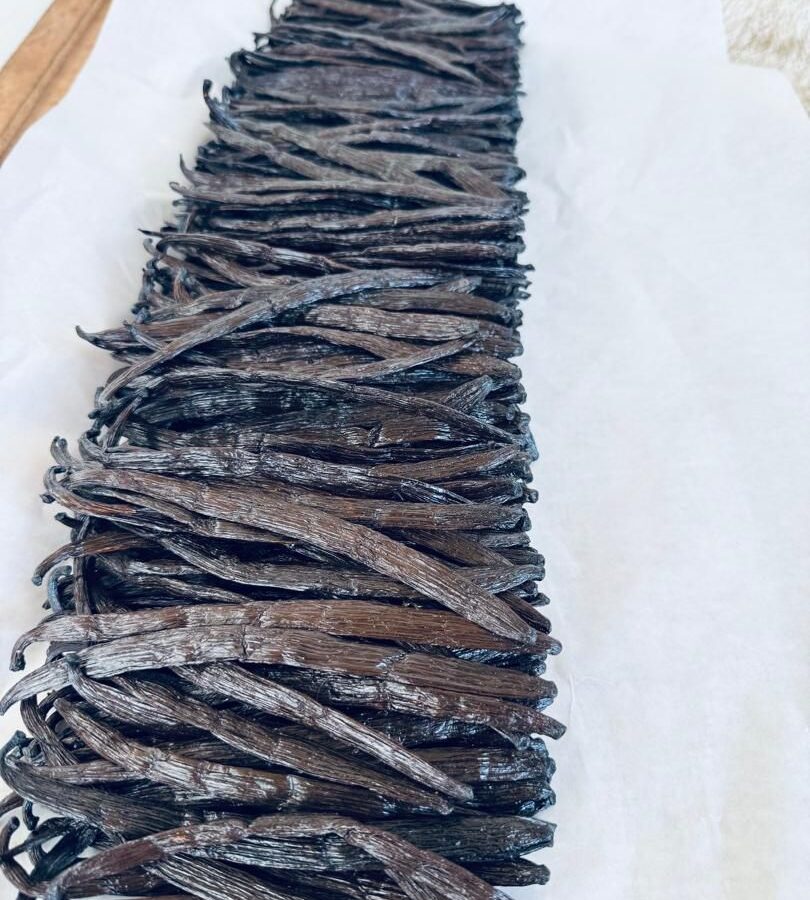
The difference in one table
Figures below are Evanille’s own Ugandan lots — a real supplier’s specs rather than the vague ranges most guides repeat.
| Attribute | Grade A (Gourmet) | Grade B (Extract grade) |
|---|---|---|
| Moisture content | 32% | 28% |
| Vanillin | 2.5% | 2.5% — identical |
| Appearance | Plump, oily, glossy, supple — wraps around a finger without cracking | Matte; may show splits, scarring or short lengths |
| Length | 5–6 in (13–15 cm) | 5–6 in (13–15 cm); includes shorter beans and splits |
| Beans per lb | 125–150 | 125–150 |
| Dry bean solids per pound | 68% | 72% — about 6% more |
| Ease of scraping caviar | Easy — soft, moist pod | Harder — pod is drier |
| Price per pound (ours) | $82 | $44 |
| Flavor cost-efficiency | Lower | Highest |
| Best for | Whole-bean use: scraping, infusing, presentation | Extraction, grinding, powder, high-volume flavoring |
Read the first two rows together, because most vanilla writing gets this wrong. The moisture gap is four points, not a chasm — a pound of Grade B carries about 6% more dry bean solids than a pound of Grade A, and vanillin is 2.5% in both. Anyone telling you Grade A is “mostly water” is describing beans that do not exist.
The insight that actually matters is in the price row. You pay roughly double per pound for a bean with 6% fewer solids. That premium buys cosmetics — exactly what you want when the bean itself is the star, and exactly what you don’t want when it’s going into an alcohol tank.
What “extract grade” actually means
“Extract grade” is simply the industry’s working name for Grade B, and it describes the destination, not a defect. When beans are destined for extraction:
- Appearance is irrelevant. Splits, surface blemishes, and short lengths change nothing once beans are chopped and submerged. This is the whole reason the grade exists, and the whole reason it is cheap.
- Split pods are a head start. Extract-grade lots arrive largely split, so alcohol reaches the seeds and inner wall on contact instead of after you do the knife work.
- Lower moisture is a small feature, not a large one. The FDA’s single-fold standard — 13.35 oz of beans per gallon — is written for beans at 25% moisture or less. Almost no cured bean is that dry, so both grades need adjusting: our Grade B at 28% needs about 13.9 oz per gallon, and Grade A at 32% needs about 14.7 oz. Grade B saves you roughly 5% of the bean weight per gallon. Worth having; not worth pretending it is the main event.
So when a listing says “extract grade,” read it as: the same vanilla at half the price, minus the photogenics. Full ratio math and method in our guide: how to make vanilla extract to the FDA standard.
What Grade A buys you
Grade A earns its price when the bean is used as a bean:
- Scraping caviar — the moist pod opens cleanly and yields soft, oily seed paste for custards, ice cream bases, buttercreams, and anywhere visible vanilla flecks signal quality.
- Whole-pod infusion — crème brûlée, poached fruit, syrups, vanilla sugar: the supple pod releases flavor readily and can often be rinsed and reused once.
- Presentation and retail — a pod in the jar or tied to the product is a Grade A job; customers judge with their eyes.
- Vanilla bean paste production — premium pastes typically start with gourmet-grade beans for both flavor and visual seed density.
A note on origin, since grade is only half the buying decision: within any grade, origin sets the flavor profile. Ugandan beans bring a bolder, chocolate-toned Bourbon profile with vanillin at 2.5% — the same in both grades — which is why they punch above their price in blind tastings against Madagascar.
The price logic, made explicit
Run it with our real numbers (full ladder on current wholesale pricing):
- A pound of Grade A at 32% moisture contains 0.68 lb of bean solids, and costs $82.
- A pound of Grade B at 28% moisture contains 0.72 lb of bean solids, and costs $44.
That is $121 per pound of bean solids in Grade A against $61 in Grade B — you pay roughly double for 6% less actual vanilla, and identical vanillin. For extraction, the wrong trade every time. For a pastry case where one beautiful pod garnishes a $12 dessert, trivially the right one. Neither grade is “better value” in the abstract — value is defined by use.
Notice which half of that comparison is doing the work. The solids difference is a rounding error; price is the entire argument, and it is more than large enough on its own.
Which grade for which buyer
Home bakers and enthusiasts Mostly scraping beans into recipes? Grade A gourmet. Making a year’s supply of homemade extract? Grade B — a single pound legally yields about 1.15 gallons of single-fold extract.
Bakeries and pastry programs Usually both: Grade A for plated work and custards where flecks and aroma presentation matter; Grade B for house extract, vanilla sugar, and batch flavoring. Splitting the order by use typically cuts vanilla spend 20–40% with zero flavor loss.
Extract producers Grade B, almost without exception. Your unit economics are (cost per pound of bean solids) ÷ (gallons of legal single-fold produced) — and Grade B wins that equation structurally. Buy on stated moisture specs and lot traceability, not photos.
Food manufacturers Grade B or splits/cuts for anything blended, ground, or extracted; Grade A only where whole-bean identity is part of the finished product. At manufacturing volume, the grade decision is a six-figure decision — talk to a supplier who publishes bulk and pallet-level pricing rather than quoting by inquiry.
Distributors and repackers Carry both, and educate your customers on exactly this split — “extract grade” remains the most under-explained term in retail vanilla, and the seller who explains it earns the trust (and the repeat orders).
One warning: grade ≠ quality control
Grading tells you moisture and looks. It does not tell you whether beans were picked ripe, cured properly, stored well, or handled without mold. A gorgeous “Grade A” bean picked green and quick-dried will have beautiful photos and hollow flavor.
That’s why the supplier matters more than the grade label. Evanille sources, cures, and grades at our own operation in Uganda, QCs every lot before export, and ships from our Florida warehouse with full lot-level traceability — the same chain of custody behind both our Grade A gourmet and extract-grade lines.
FAQ
What does “extract grade” vanilla mean?
Extract grade is the trade name for Grade B vanilla beans: slightly lower moisture (28% against Grade A’s 32% in our lots), less cosmetically perfect, often split, and priced roughly half of Grade A. The name reflects their ideal use — extraction — where appearance is irrelevant. Vanillin is identical at 2.5%; the marginally higher solids content is a small bonus on top of the price, not the reason to buy.
Are Grade B vanilla beans lower quality than Grade A?
No. Both grades come from the same plants and the same curing process, and both test at 2.5% vanillin; the grade reflects moisture content and appearance only. Gram for gram of dry matter the flavor is equal — and per dollar, Grade B is far ahead. Quality problems (under-ripe picking, poor curing, mold) are supplier issues, not grade issues.
Can I use Grade A beans to make vanilla extract?
Yes, and it tastes excellent — the vanillin is identical. It’s just expensive. At 32% moisture the FDA’s single-fold math requires about 14.7 oz per gallon instead of Grade B’s 13.9 oz (neither uses the textbook 13.35 oz, which assumes beans at 25% moisture). So you need about 5% more bean weight and you pay roughly double per pound for it. Reserve Grade A for whole-bean uses.
Can I use Grade B beans for baking?
Absolutely — the flavor is all there. The pod is just drier, so caviar is harder to scrape cleanly. Practical workarounds: grind Grade B beans whole into vanilla powder, steep them in warm liquid ingredients, or rehydrate briefly. For visual seed-fleck presentation, Grade A is easier to work with.
Is there a Grade C vanilla bean?
Some origins and sellers use Grade C (or “cuts/splits”) for short, split, or very dry beans. They’re the deepest value tier for extraction and grinding — the flavor compounds don’t know the bean was short. Evanille sells splits within our extract-grade line with the same lot traceability.