
Vanilla Beans for Bakery & Pastry
Every pastry kitchen wastes money on vanilla in one of two directions: paying bean prices for a chocolate cake batter where nobody could tell, or using imitation flavoring in a crème pâtissière where everybody can.
This page sorts that out. Where whole beans earn their cost and where extract is the professional choice, what to dose by recipe scale, how much caviar a pod actually yields, what it costs per plated dessert, and how much to keep in the dry store.
Buying by the pound or the kilo? See current pricing or text us at +1 786-896-8446 — we’ll call you back.
Where whole beans matter — and where they don’t
The rule is simple and it saves real money: beans go where the product is pale, gently cooked, and the vanilla is the point. Extract goes where the product is dark, baked hot, and the vanilla is a background note.
Use whole beans:
- Crème pâtissière, crème anglaise, diplomat and mousseline
- Crème brûlée, pot de crème, flan, custard tarts
- Panna cotta, bavarois, vanilla mousse
- Ice cream and gelato bases (see our ice cream and gelato page)
- White chocolate ganache, vanilla mirror glaze, macaron fillings
- Vanilla buttercream, Chantilly, pastry-case display items
Use extract (and don’t apologize for it):
- Cookie dough, brownies, blondies
- Chocolate cake, devil’s food, anything cocoa-forward
- Muffins, quick breads, scones
- Laminated dough, croissant, any product baked above 350°F for more than a few minutes
The reason is mechanical, not snobbery. Vanilla’s aroma compounds are volatile; a long bake at high heat drives a large share of them off, and in a dark crumb the caviar is invisible anyway. You’ve paid for specks nobody sees and top notes that left in the oven. In a gently cooked custard at 180°F, held covered, almost everything you put in stays in — and the seeds are the visual signature the product is priced on.
If you want real vanilla in hot-baked goods anyway, make your own extract from lower-cost extract-grade beans — our extract guide has the FDA ratio and yield math. A pound of Grade B — $44 from us — makes about 1.15 gallons of single-fold extract, a far better use of that pound than scattering it through cookie dough.
Dosage by recipe scale
Grade A beans at 5–6 inches (13–15 cm) run roughly 3.3 grams each, about 125–150 beans per pound. Set your specs in grams; bean count varies too much between lots and suppliers to be a reliable unit.
| Application | Batch scale | Beans | Notes |
|---|---|---|---|
| Crème pâtissière | 1 L milk | 1–1.5 | Caviar in, pod steeped and strained |
| Crème anglaise | 1 L milk/cream | 1 | Infuse covered, 30 min off heat |
| Crème brûlée / pot de crème | 1 L cream | 1.5–2 | Vanilla is the entire flavor; dose up |
| Panna cotta | 1 L cream | 1 | Steep before setting with gelatin |
| Ice cream / gelato base | 1 L mix | 1 | See the ice cream page |
| White chocolate ganache | 1 kg chocolate | 1 | Infuse the cream, strain, then emulsify |
| Vanilla buttercream | 1 kg finished | 0.5 caviar + 10 mL extract | Caviar for specks, extract for reach |
| Chantilly / whipped ganache | 1 L cream | 0.5–1 | Infuse the cream cold overnight |
| Vanilla sugar | 1 kg sugar | 2–3 spent pods | Free flavor from used pods |
| Cookie, cake, muffin batter | 1 kg flour | 10–15 mL extract | Beans are wasted here |
Vanilla bean caviar: technique and real yield
The technique. Lay the pod flat, hold the tip, and run the point of a paring knife down its length to split it — one clean pass, not a sawing motion. Open it out and scrape tip to tip with the back of the blade. The blunt edge lifts the seeds and leaves the pod wall intact; the sharp edge shreds it and you lose the pod for secondary use. If a bean is stiff, warm it 30 seconds in your hand or a low oven and it scrapes twice as easily.
The yield. One plump Grade A bean gives roughly ½ to 1 teaspoon of caviar — about 0.5 to 1 gram. That’s it. The seeds weigh almost nothing, and the bulk of the pod’s flavor is in the pod wall, not the caviar. This is why the pod goes into the infusion and only comes out at the strainer. Scraping and discarding the pod throws away most of what you bought.
Dispersion. Seeds clump in cold liquid. Rub the caviar into a portion of your sugar first — you’ll get even flecking instead of black knots.
Don’t throw the pods away
Spent pods from a strained infusion still carry real flavor. Rinse, then dry them thoroughly — 48–72 hours on a rack in a dry spot, or 20 minutes in an oven at its lowest setting — then bury 2–3 pods per kilo of granulated sugar for two weeks (vanilla sugar for tuiles, sablé, dusting, meringue), or grind and sieve them into vanilla powder for dry mixes and macaron shells. A used pod will also still perfume a syrup or poaching liquid.
Pods must be bone dry before storage — residual moisture in a sealed jar is how you get mold. Details in our storage guide.
Cost per unit produced
Our Grade A gourmet is $82 per pound, and a pound holds 125–150 beans — so one bean costs about $0.60. (At the US retail-bulk benchmark of roughly $100/lb, the same bean is about $0.73.)
| Product | Vanilla per batch | Units per batch | Vanilla cost per unit |
|---|---|---|---|
| Crème pâtissière, 1 L | 1.5 beans (~$0.90) | ~30 tart shells | ~$0.03 |
| Crème brûlée, 1 L cream | 2 beans (~$1.20) | ~10 ramekins | ~$0.12 |
| Panna cotta, 1 L cream | 1 bean (~$0.60) | ~8 portions | ~$0.08 |
| Vanilla buttercream, 1 kg | 0.5 bean (~$0.30) | ~12 filled cakes’ worth | ~$0.03 |
| Gelato base, 1 L | 1 bean (~$0.60) | ~11 scoops | ~$0.05 |
Three cents of vanilla on a tart that sells for six dollars. The cost objection is almost always an artifact of buying beans at retail prices in tubes of two. At pound and kilo pricing, real vanilla is one of the cheapest quality upgrades a bakery can make — and one of the few a customer can see across a display case. Full ladder on our prices per pound and per kilo.
Monthly volume guidance
- Small bakery / café patisserie — 8–12 L of custard and cream work per week → about 1 lb per month
- Full-service bakery with a pastry case — 25–35 L per week → 1.5–2.5 lb per month
- Restaurant group or multi-outlet pastry kitchen — 60–80 L per week → 5–6.5 lb (2.2–3 kg) per month
- Commercial baking / co-packing — order against your production schedule on wholesale tiers
Order roughly a quarter at a time. Beans hold well for 6–12 months sealed, cool and dark, and moving from pound to kilo units is a straightforward cost reduction if your dry store is stable.
Buying from Evanille
Evanille owns its supply chain: sourcing, curing, grading, QC and export in Uganda, then US stock in a Florida warehouse. No broker sits between the curing bed and your bench, which is why we can give you moisture content, grading date and lot on any box we ship.
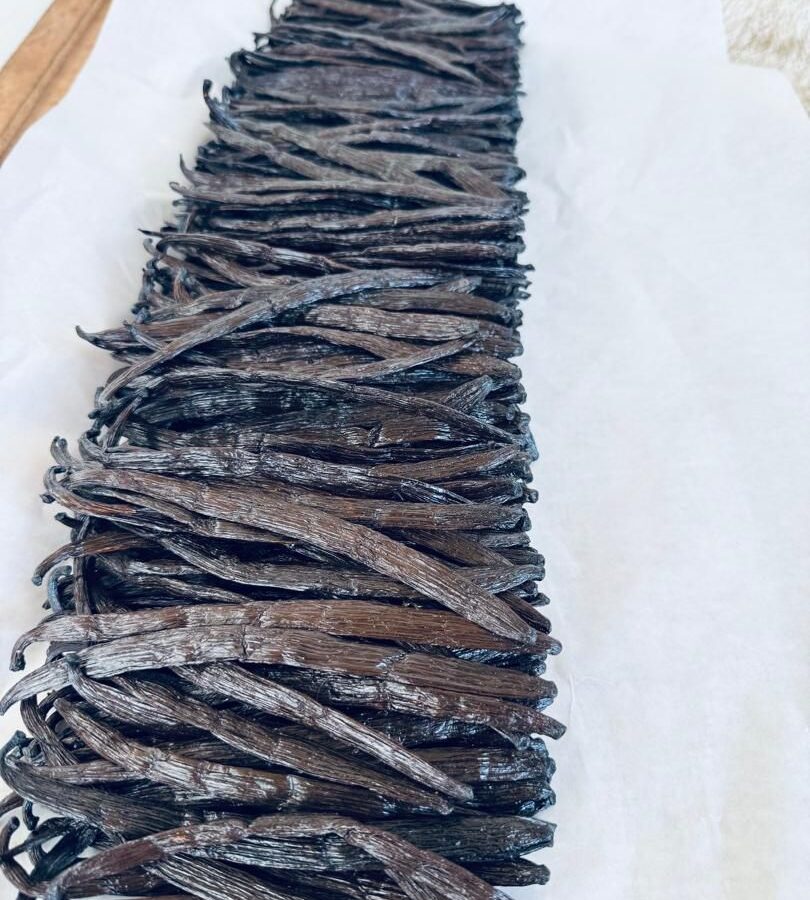
- Grade A gourmet — 32% moisture, plump, pliable, scrapes cleanly. The pastry default. $82 per lb, $165 per kg, up to the 10 kg box ($1,200 · $120/kg) and 25 kg splits case ($1,500 · $60/kg)
- Extract grade / Grade B — for in-house extract and steep-and-strain work. $44 per lb, $88 per kg, 20 kg boxes ($1,200 · $60/kg) in US stock, down to $40/kg at 500 kg+; tonne lots quoted under contract
- Splits and cuts — same 2.5% vanillin, cosmetic seconds, lower price. Ideal where the pod gets strained out
- Two harvests a year in Uganda, December–February and June–August — we restock twice annually, so there’s no single-harvest gap in your supply
Ugandan Vanilla planifolia runs high in vanillin — 2.5% in our lots, both grades — with a bold, chocolate-toned profile that stands up in dark chocolate work and frozen desserts, where softer origins fade. More: our Uganda operation.
Browse all vanilla beans, check pricing, or text +1 786-896-8446 with your weekly volume — we’ll tell you what to order and how often, and send samples.
FAQ
How many vanilla beans do I need for 1 liter of pastry cream?
1 to 1.5 beans (about 3.5–5 grams) per liter of milk. Scrape the caviar in, steep the split pod in the hot milk covered for 30 minutes, and strain the pod out before finishing. Ours run 3.0–3.6 g each at 125–150 beans per pound, but bean weight varies between suppliers, so dose by weight rather than by count.
When should a bakery use vanilla beans instead of extract?
Use beans wherever the product is pale, gently cooked, and vanilla-led: pastry cream, crème anglaise, brûlée, panna cotta, ice cream bases, white chocolate ganache, buttercream. Use extract in cookie dough, brownies, chocolate cakes and anything baked hot — long high-heat bakes drive off the volatile aromatics and the caviar is invisible in a dark crumb.
How much caviar does one vanilla bean yield?
About ½ to 1 teaspoon — roughly 0.5 to 1 gram from a plump Grade A pod. Most of a bean’s flavor is actually in the pod wall, not the seeds, so always infuse the scraped pod rather than discarding it.
What does real vanilla cost per dessert?
At our $82 per pound of Grade A (125–150 beans, about $0.60 each), vanilla runs about $0.03 per tart filled with pastry cream, $0.12 per crème brûlée, and $0.05 per scoop of gelato. Even at the $100/lb retail-bulk benchmark those figures only rise to about $0.03, $0.15 and $0.07. Buying at pound and kilo pricing rather than retail tubes is what makes them work.